It builds. It ships. It never stops improving.
An autonomous platform that builds your product, studies your competitors, ships features every night, and obsessively serves your customers — with enterprise-grade infrastructure from day one.
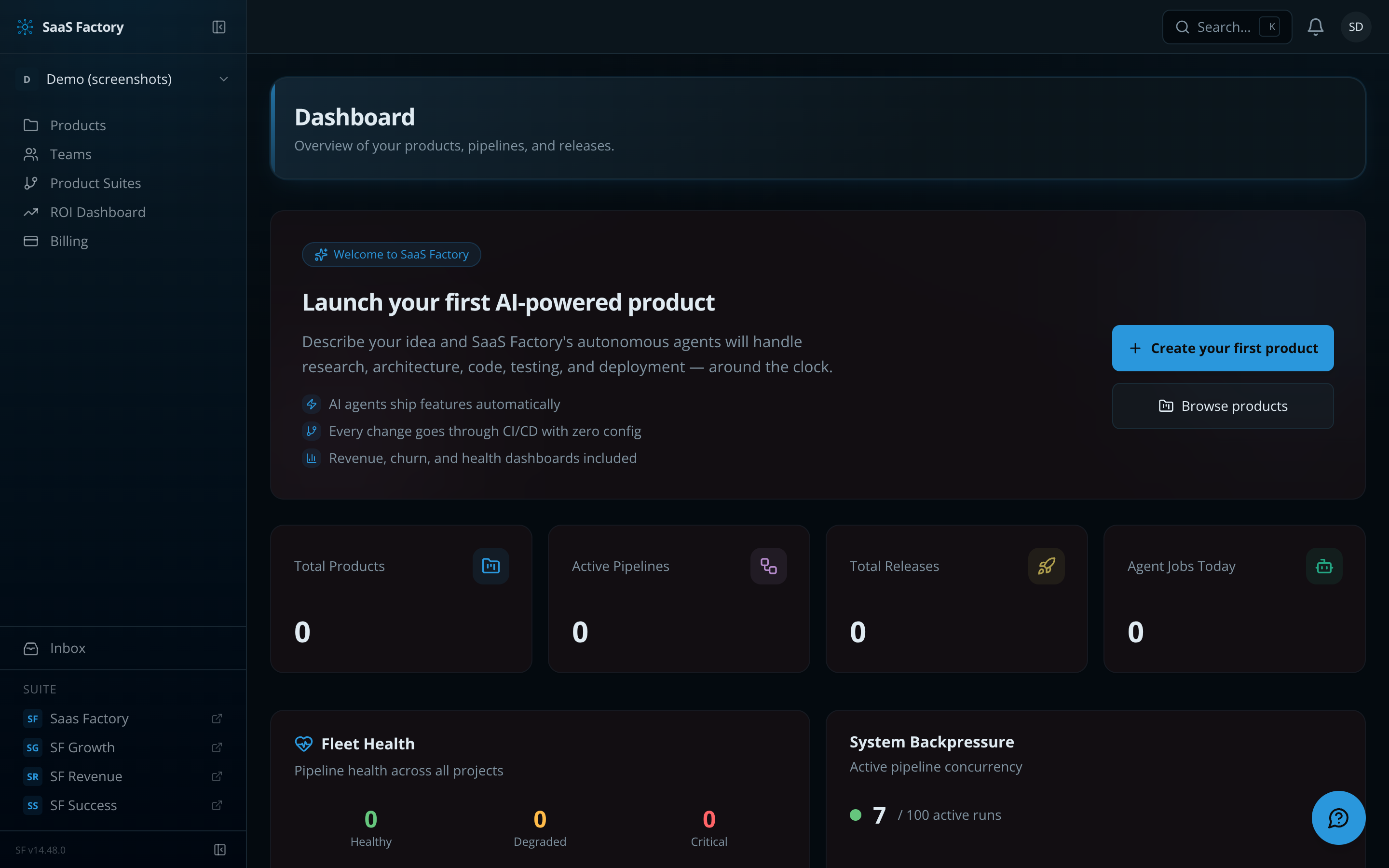
Describe your product, its mission, and target vertical. SaaS Factory provisions infrastructure, scaffolds a production codebase, and deploys it on Vercel backed by Neon Postgres — all before you close the tab.
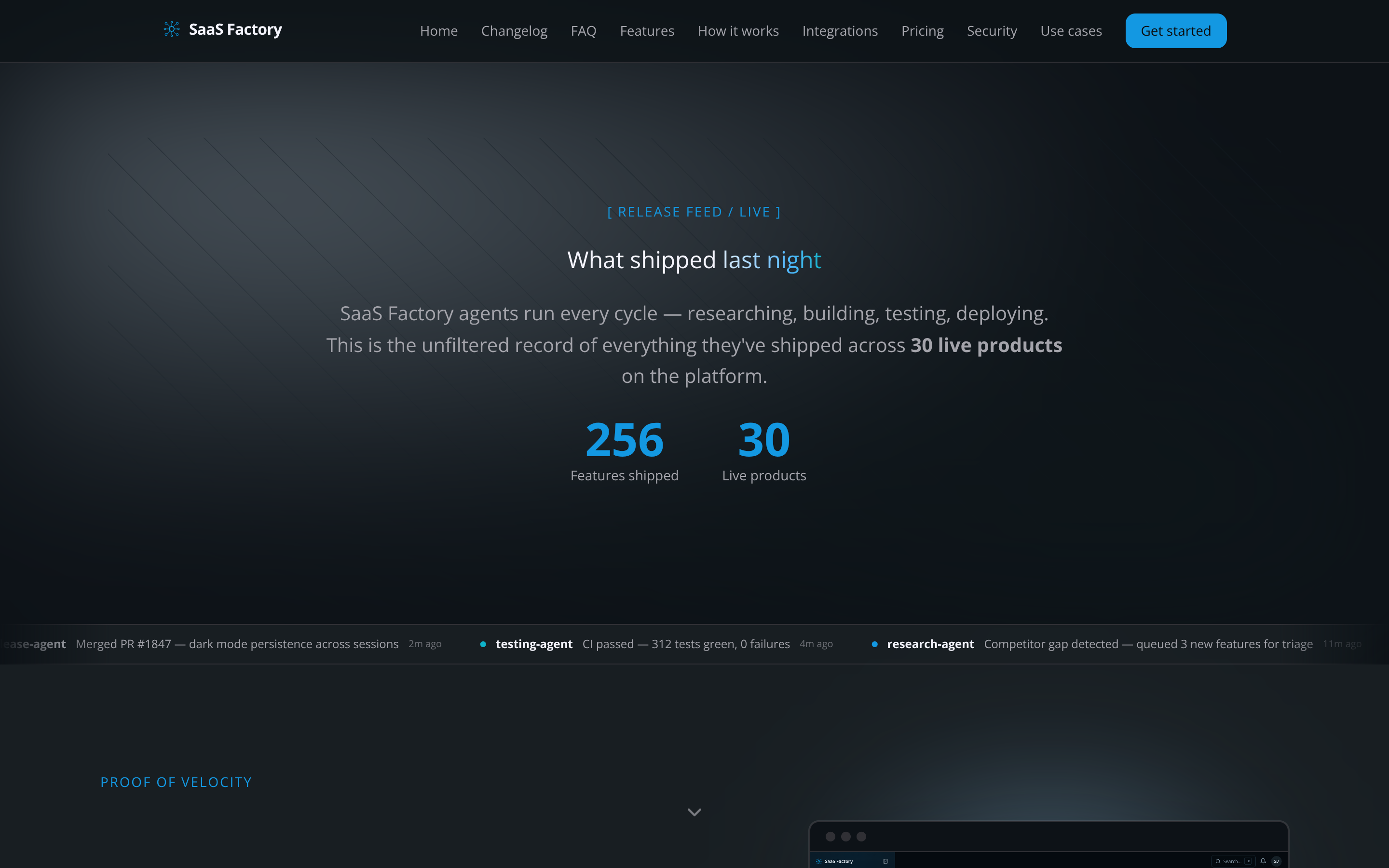
The unified agent loop kicks off every 30 minutes. Research agents mine competitor feature gaps. Design agents write specs. Implementation agents open PRs. Testing agents run CI. Release agents merge and deploy.
The AI Worker scores customer health, detects churn risk, and surfaces upsell signals. Support tickets are classified and resolved by AI. Revenue analytics track MRR in real time.
No human approvals required. The compliance agent audits every change. The marketing agent promotes every release. The failure recovery system quarantines bad deploys.
Give SaaS Factory an idea. It provisions infrastructure, generates a production codebase, deploys it, and never stops improving it — discovering features from competitors, writing and testing code, shipping releases, and serving your customers.
Questions? Email us at sf-core-org-support-saas-factory@saas-factory.ai
Every product SaaS Factory generates ships with a built-in API, MCP Server, and AI Worker — the three primitives that make modern AI-native products possible.
Every generated product ships with a versioned REST API at /api/v1/* — with API key auth, rate limiting, and OpenAPI docs. External systems connect on day one.
A full Model Context Protocol server at /api/mcp/[projectId]/sse — let Cursor, Claude Desktop, and any MCP-compatible tool call your product's functions directly. OAuth-secured per project.
Research agents find opportunities. Design agents write specs. Implementation agents write production code. Testing agents verify it. Release agents ship it. Marketing agents promote it. Compliance agents audit it.
Competitor gap discovery Research agents scan rivals weekly and queue the gaps as features automatically.
Autonomous PR lifecycle From spec to merged PR — code is written, tested, and shipped without a human in the loop.
Nightly release cycle Every night, the release agent tags a version, writes notes, and deploys to Vercel.
Every product on the platform ships with a full billing engine, subscription analytics, churn prediction, deal pipeline, and AI-powered CRM — not as integrations, but as first-class agents.
MRR time-series, ARR summary, cohort retention, expansion/contraction breakdowns, and subscriber lifecycle funnel — all from live billing data with real SQL aggregations.
A six-dimension weighted heuristic model scores every customer — payment history, inactivity, usage trend, lifecycle stage, renewal proximity. Upsell opportunities surface automatically.
The same stack that powers the platform itself runs inside every product it ships. Security, compliance, and reliability are structural — not features you unlock later.
CSP headers, encrypted secrets, row-level security, audit logging for all mutations, and GDPR data deletion pipelines — wired in before the first line of product code.
The MCP Server at /api/mcp/[projectId]/sse exposes your product's functions as tools for Cursor, Claude Desktop, and any Model Context Protocol client. OAuth-secured per project — connect once, call from any AI tool.
SSE endpoint with Bearer + OAuth token auth
Tool usage tracked per API key in mcp_tool_usage
MCP config managed per product in the dashboard
Works with Cursor, Claude Desktop, and any MCP client
A daily scheduler re-analyses every tracked competitor (lastAnalyzedAt < 7 days). Discovered capability gaps are queued as features automatically — closing the loop between research and shipping.
Per-product competitor tracking at /dashboard/competitors
Weekly re-analysis cron with diff detection
Competitor gaps surfaced in the feature queue
The testing agent writes and runs tests for every PR. CI results stream back to the platform. Three consecutive failures trigger an auto-fix feature in the queue.
Playwright-powered visual tests capture screenshots per route. Visual diffs surface before merge — the same capability that generates onboarding documentation for shipped products.
A persistent background AI worker that handles async jobs — churn scoring, health analysis, competitor re-analysis, data exports, and more — without blocking the main app thread.
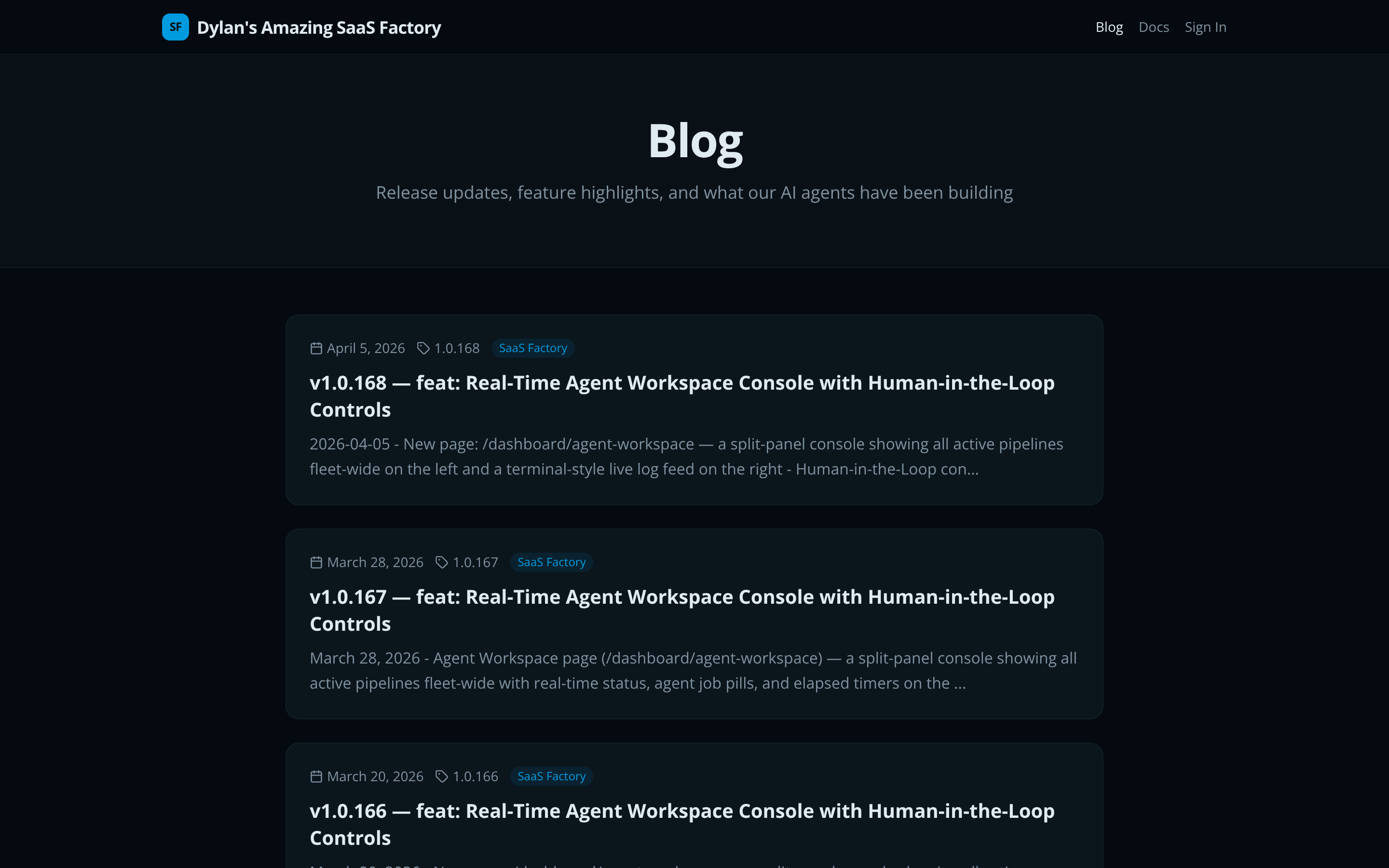
Marketing agent on every release Blog posts and social copy generated for every shipped version — stored and ready to publish.
Every pipeline run is logged: which agents ran, how long each took, how many tokens were consumed, and exactly what was shipped. Live SSE streaming shows you the current run as it happens.
Per-agent token usage and duration tracking
Live pipeline stream at /dashboard/pipelines/:id
Approval gates for human review moments
Pipeline failure auto-detection and recovery queue
Public changelog per product — proof of velocity
Customer health scores, NPS tracking, engagement events, and proactive outreach logs. The CRM agent monitors every customer signal and escalates at-risk accounts.
A full leads-and-deals system with a 100-point AI scoring model across firmographic, BANT, ICP match, and engagement dimensions. Kanban board, stage automation, and activity log included.
Lead nurture sequences triggered on creation
Deal staleness escalation with AI next-action hints
Win-back campaigns on cancellation
Every inbound support ticket is classified by Claude, matched against the knowledge base, and resolved with an AI-written reply sent via email. Escalation happens only when confidence is low.
12-step resolution pipeline with real Anthropic API calls
CSAT follow-up and KB article suggestion
Priority routing and SLA tracking
Every product gets its own isolated Neon Postgres database, provisioned per-region. Connection pooling, branching, and point-in-time restore included at the infrastructure layer.
Automated deploy on every merged PR. Rollback hooks tracked in the releases table. Zero-downtime deploys with Vercel's preview and production environments.
Per-channel webhooks for email, Slack, and Discord — 7 event types including revenue drops and churn spikes. Configured per product, dispatched by the platform in real time.
Data deletion requests, data export fulfillment, consent records, and audit trails run as nightly batch jobs. SOC2, HIPAA, and ISO audit trails built into every mutation.
Encrypted env var management with real-time Vercel sync. GitHub, Vercel, and Twilio credentials validated live. Push to Vercel with one API call.
The platform also ships a public REST API at /api/v1/* with API key management, rate limiting, and per-key usage analytics — so developers can integrate without touching the dashboard.
A dedicated Product Owner agent manages mission, roadmap, and suite coordination. Ask it questions in the context window and it reasons about your product's direction — storing decisions and translating them into queue priorities.
Mission and roadmap views at /product-owner/mission
Suite chat for multi-product coordination
Team context and role management per product
Dedicated error monitoring, error resilience scoring, and supply chain audit views per product. Pipeline failures auto-quarantine bad releases. Stale runs recover nightly.
